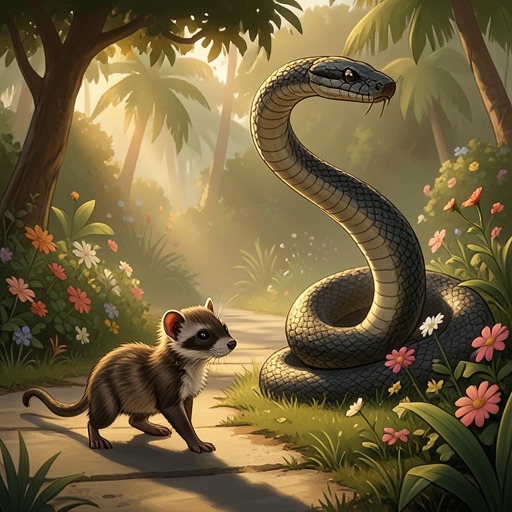
Rikki-tikki-tavi and Nag
The Jungle BookRikki-tikki-tavi and Nag are defined by a direct, escalating enmity: the mongoose exists to fight snakes, while the cobra recognizes that his presence in the garden may ultimately mean death for himself and his family. Their conflict is not merely a contest between two animals. It determines whether the garden remains a shared refuge protected by the human household or becomes territory ruled by Nag and Nagaina, and it forces Rikki-tikki to turn instinctive courage into deliberate strategy.
The Natural Enemies
Rikki-tikki first encounters Nag when Darzee and his wife, already frightened because Nag has eaten one of their babies, remain hidden in their nest. Nag rises from the grass as a five-foot black cobra, spreading his hood and displaying the spectacle-mark on its back. He invokes the mark as a sign of authority and tries to make the young mongoose afraid. Rikki-tikki is frightened briefly, but his fear cannot last: his mother fed him dead cobras, and he knows that fighting and eating snakes is the central business of a grown mongoose. Nag understands the same fact from the opposite side. At the bottom of his cold confidence, he is afraid of the mongoose.
Their first exchange reveals the moral as well as physical structure of the rivalry. Rikki-tikki challenges Nag over eating fledglings, while Nag attempts to justify himself by comparing a mongoose's appetite for eggs with a cobra's appetite for birds. The argument is a delaying tactic. Nag watches the grass behind Rikki-tikki while Nagaina creeps into position, intending to strike from the rear. Rikki-tikki detects the danger only when Darzee warns him; he leaps as Nagaina's head flashes beneath him and lands across her back. He bites, but releases too soon because he fears the cobra's return stroke. The encounter leaves Nagaina wounded and angry, while Rikki-tikki learns that facing the pair together would exceed his present confidence.
The Garden as Territory
Nag's hostility becomes more dangerous when it joins a larger territorial plan. In the bathroom sluice, Rikki-tikki overhears Nagaina telling Nag that the human inhabitants must be killed. Once the bungalow is empty, she argues, the garden will belong to them again; their eggs in the melon bed are about to hatch, and their offspring will require space and quiet. Nag initially questions whether killing the people will accomplish anything, but he accepts the plan and decides to attack the big man, his wife, and, if possible, the child.
This conversation changes the meaning of the rivalry. Nag is not merely defending himself from a new predator or retaliating for a failed ambush. He is trying to remove the human presence that prevents cobra sovereignty over the garden. Rikki-tikki's response is immediate and visceral: he feels rage and hatred, but also genuine fear when Nag's five-foot body enters through the sluice. The threat to Teddy's family converts the mongoose's personal danger into a protective obligation. The garden's political order is now at stake, and Nag's proposed violence gives Rikki-tikki no safe option of withdrawal.
The Bathroom Ambush
Rikki-tikki refuses to attack Nag on the open floor, where the cobra's size would give him the advantage. He waits while Nag coils around the base of the large water jar and falls asleep. Moving slowly toward the jar, Rikki-tikki considers where to bite. The neck is too thick, a bite near the tail would only enrage Nag, and a missed attack would leave the cobra able to fight. He concludes that the only viable target is the head above the hood and that, once he reaches it, he must not let go.
The attack is therefore an act of judgment as much as courage. Rikki-tikki leaps onto Nag's head and braces his back against the curve of the red earthenware jar, gaining a single moment of purchase. Nag thrashes him across the bathroom like a rat shaken by a dog, upsetting the dipper, soap dish, and flesh brush and striking the side of the bath. Rikki-tikki keeps his jaws locked even as the cobra's body cartwheels over the floor. He expects to be battered to death and regards holding on as a matter of family honor.
The decisive intervention comes from the human household. Awakened by the struggle, the big man fires both barrels of a shotgun into Nag just behind the hood. The blast leaves Rikki-tikki stunned and singed, but his bite has held the cobra in place long enough for the shot to kill him. The mongoose initially believes himself dead as well; then the head remains motionless, and the big man recognizes that the little animal has saved the household. Nag's death is thus produced by a partnership between animal persistence and human force, although Rikki-tikki's grip makes the shot possible.
Aftermath and the Remaining Threat
The garden learns of Nag's death through Darzee's triumphant song. Darzee celebrates that Rikki-tikki caught Nag by the head and held fast until the big man brought the gun, and he rejoices that Nag will never eat his babies again. Rikki-tikki refuses to treat the victory as complete. He immediately asks where Nagaina is, because Nagaina remains capable of renewing the danger. The contrast between Darzee's celebration and Rikki-tikki's vigilance shows that killing Nag has removed only one half of the enemy power.
Nagaina soon emerges and heads toward the long grass and the rat-hole where she and Nag live. Darzee's wife delays her by flapping around her hood, but Nagaina continues toward the hole. Rikki-tikki catches her tail at the entrance and follows her underground, despite the danger that the passage may open into a space where she can turn and strike. He braces his feet against the hot, moist earth and holds on in the darkness. The sequence reverses the earlier bathroom struggle: Nag fought in an open human space and was killed with a weapon, whereas Nagaina draws Rikki-tikki into the private depth of the snakes' own dwelling.
Darzee assumes that Rikki-tikki has been killed and begins a death song. The apparent defeat becomes another test of the relationship's value: the garden's defenders believe that the mongoose has sacrificed himself to end the threat. Then the grass moves, and Rikki-tikki emerges covered in dirt, licking his whiskers. He declares that the widow will never come out again. He has survived the underground pursuit and completed the destruction of Nag's immediate family threat, though the evidence of this victory reaches the garden first as uncertainty and mourning rather than certainty.
Significance of the Enmity
The Rikki-tikki-tavi–Nag relationship is built from opposed forms of belonging. Nag claims the garden as ancestral or natural territory and seeks to clear it of people so that his family can reproduce undisturbed. Rikki-tikki, by contrast, becomes the household's defender after entering the garden as a stranger. His allegiance is shown through action: he risks himself for Teddy's family, for Darzee's nest, and for the continued safety of the garden's inhabitants.
Their conflict also gives physical shape to a contest between concealment and watchfulness. Nag uses grass, darkness, conversational deception, and the bathroom sluice; Rikki-tikki answers with alertness, controlled timing, and a refusal to release his grip once the decisive attack begins. The cobra's apparent majesty—the raised hood, the sacred mark, the immense body—cannot overcome the mongoose's ability to identify the exact moment and place in which strength can be defeated. Nag's death therefore completes the rivalry's central reversal: the larger and more intimidating predator is destroyed by the smaller opponent who understands that survival depends on choosing the head, holding fast, and accepting the cost of the fight.